




Retinal detachment in dogs and cats
The retina is a thin membrane lining the eyeball, designed to receive light impressions and transmit them to the optic nerve.
You could say it’s the equivalent of a camera sensor, as it captures light rays. It then transmits them to the central nervous system, which interprets the information. It is therefore indispensable to vision. The visual retina or neuroretina, which houses the photoreceptors, is located between the pigment epithelium that nourishes it and the vitreous that buffers it in place. When the neuroretina is separated from the pigment epithelium, we speak of retinal detachment. This condition rapidly leads to blindness.
What are the symptoms of retinal detachment in dogs?
The symptoms of retinal detachment can be discreet in our patients, as animals compensate with the healthy eye. An attentive owner will sometimes detect unilateral damage and notice that his companion always bumps into the same side, or does not react when presented with an object (a kibble, for example) on the same side. Unfortunately, most of the time, he won't notice an anomaly until both eyes are affected. He will then notice the presence of blindness, which manifests itself as hesitation or difficulty in moving around, the animal sometimes bumping into obstacles in its path, or advancing its nose along the ground using its sense of smell.
What are the consequences of retinal detachment?
Once detached, the retina is no longer nourished, and a process of photoreceptor destruction begins. The more time passes, the more severe this destruction becomes, becoming irreversible after a while. In humans, retinal detachment needs to be operated on within 4 to 7 days, whereas in dogs it can take up to a month. Some veterinary ophthalmologists have observed recovery beyond this period. It should be noted that it is often difficult to determine the exact date of detachment, especially as it may have evolved gradually. The presence of inflammation or bleeding complicates the prognosis.
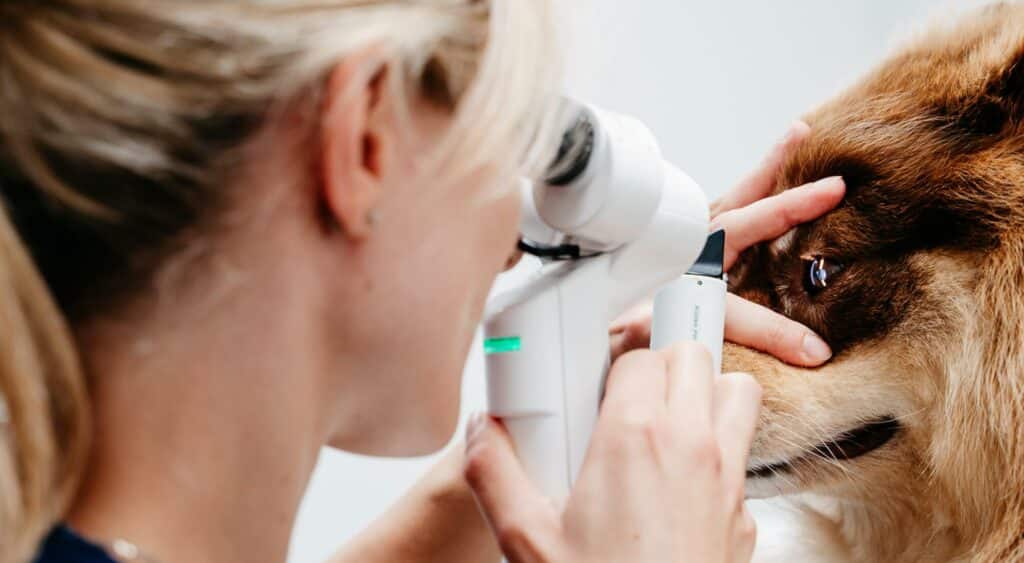
How is retinal detachment treated?
If left untreated, retinal detachment leads to irreversible blindness . Treatment consists in restoring contact between the neuroretina and the pigment epithelium. When the retina is not torn, and the two layers are separated by the accumulation of fluid, it is sometimes possible to resort to medical treatment. This is the case with hypertension or chorioretinitis. However, most retinal detachments in dogs are accompanied by a tear, in which case surgical treatment is indicated. This involves performing a posterior vitrectomy, reapplying the neuroretina and then fixing it using a laser. This delicate procedure, performed in Europe only in a few veterinary centers, requires heavy equipment and special skills available at the clinic.