




Cataracts in my dog, cat or rabbit
What is a cataract?
Cataracts correspond to partial or complete opacification of the crystalline lens. This lens is normally transparent, and its opacification is accompanied by a progressive loss of vision, leading to total blindness when the entire lens is affected.
Why does my pet have cataracts?
Cataracts don't just occur as people age. It can also be the consequence of an illness such as diabetes, ocular trauma, infectious or inflammatory disease, or even be hereditary. This etiological variety explains why cataracts can occur at any age, and even in very young animals in the case of congenital or juvenile cataracts. When cataracts are hereditary, they can be passed on from generation to generation, and some dog breed clubs recommend screening for this condition. Screening is carried out by accredited veterinarians, notably in our ophthalmology unit.

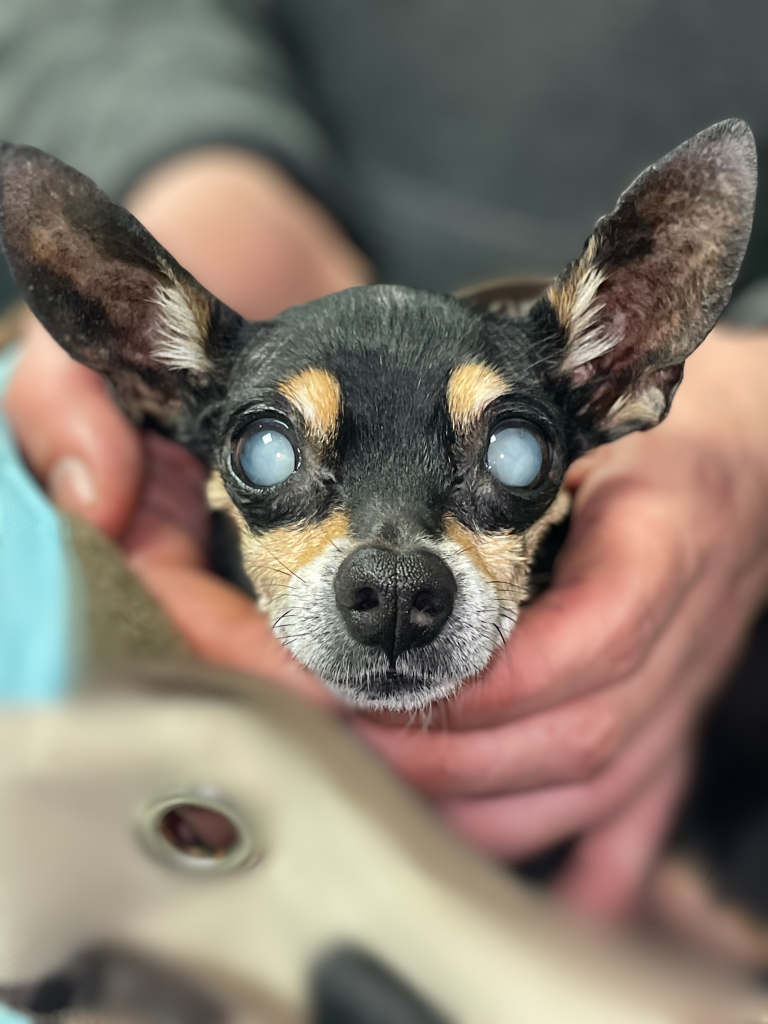
What are the signs and consequences of cataracts?
- The eye turns white: A white or bluish opacity is observed in the eye.
- Decreased vision: this can be seen in hesitation, clumsiness, refusal to move around, or even aggressiveness. Note that when cataracts affect only one eye, these signs are difficult to detect.
- If left untreated, cataracts can lead to severe inflammation of the eye, called uveitis, glaucoma, lens dislocation and retinal detachment. These complications can lead to irreversible blindness and chronic eye pain.
Can cataracts be treated, and how?
There is no effective medical treatment to prevent, slow down or reverse cataract formation.
As in humans, cataracts in dogs are treated surgically, using phacoemulsification. This is a minimally invasive technique (incision less than 3mm) which involves removing the cataract and inserting an artificial lens. This delicate procedure requires sophisticated equipment and must be performed by an experienced ophthalmic surgeon.

When should a cataract be treated?
Don't wait until your pet is completely blind: It's a mistake to wait until the cataract is complete before operating.
The risk of complications increases with time. For best results, it's best to intervene early.
Can my pet have cataract surgery?
- Pre-operative eye examination: Before deciding whether to operate on a patient's cataract, and to avoid disappointment, it is essential to ensure that the other eye structures essential for vision are functioning correctly. To this end, we carry out a pre-operative ophthalmological assessment, which includes a clinical examination, ocular ultrasound and electroretinography.
- Pre-operative general examination : As with any operation performed under general anaesthetic, a pre-anaesthetic examination is essential. This is carried out by your attending veterinarian shortly before the operation, along with the treatment of any chronic infections (ears, teeth).
How does the procedure work?
Consultations
Pre-operative preparation: In some cases, medical preparation is prescribed a few days before the operation, along with the wearing of a collar (24 to 48 hours) to get the patient used to it.
Admission: If possible, patients are admitted to the clinic the day before the operation, so that the nursing team can prepare them on site.
General anaesthesia: To guarantee maximum safety, all our anaesthesia procedures are performed using inhalation of anaesthetic gases, and are subject to rigorous monitoring.
Procedure : The surgical technique is the same as that used for men: a minimally invasive technique called phacoemulsification. In some cases, both eyes can be operated on at the same time.
Post-operative period : ophthalmological follow-up is necessary to ensure proper healing and the absence of complications. Careful monitoring is carried out in the first few hours after the operation (facilitated by a 24-hour hospital stay), followed by check-ups on D+1, D+7 and D+14.
How much does it cost and what does it include?
The cost of the procedure ranges from 1,243 to 1,434 euros, depending on whether or not an implant is used. The cost of anesthesia is added to this amount (between 172 and 344 euros). A sliding scale of charges is applied when the procedure is performed on both eyes at the same time, since in this case the block fee is applied only once. An estimate is systematically provided prior to the operation. In exceptional cases, where the surgical situation makes it necessary, additional procedures may be decided on and performed during the operation. In such cases, additional charges apply.
What is the success rate for cataract surgery?
When the prerequisites for the procedure (sufficiently recent lead times, preoperative checkups, preparation) have been met, the success rate, as in humans, exceeds 90% for well-trained operators (Immediate sequential bilateral cataract surgery in dogs: a retrospective study of 128 cases (256 eyes), T. Azoulay, T. Dulaurent, P.-F. Isard, N. Poulain, F. Goulle, Journal français d'ophtalmologie (2013) 36, 645-651).
Is cataract surgery covered by my veterinary health insurance?
Most veterinary insurance policies cover cataract surgery. However, it is advisable to check your policy before the operation.
Service news

European Congress of Veterinary Ophthalmology – Madrid
Agoravet’s ophthalmology team attended the European Congress of Veterinary Ophthalmology, which was recently held in Madrid.On this occasion, a presentation […]
Read more
Veterinary ophthalmology conference in Thionville: presentation by Dr Azoulay
Dr Azoulay, a veterinary specialist in ophthalmology at Agoravet, spoke at a conference in Thionville, organized as part of his […]
Read moreClinicat 2026-2027
Will you soon be graduating in veterinary medicine and want to start your career in a 𝗮𝗽𝗽𝗿𝗲𝗻𝗮𝗻𝘁 and 𝘀𝘁𝗶𝗺𝘂𝗹𝗮𝗻𝘁 environment?📍 […]
Read more
Dr Azoulay’s presentation at AFVAC 2025
Dr Thierry Azoulay, from the Department of Ophthalmology, will present a lecture at AFVAC 2025:” Glaucoma in dogs: when to […]
Read more