




Ophthalmology department
Service
Why choose AgoraVision, AgoraVet's ophthalmology department?
- Quality care and responsiveness: We guarantee fast, appropriate care for all eye conditions. This comprehensive range of services makes AgoraVision a unique place to care for your pets.
- Experience: We have over 30 years' experience in veterinary ophthalmology. AgoraVision treats over 3,000 patients a year, from all over France, as well as Germany, Luxembourg and Switzerland.
- Team: Our team, experienced in handling the most serious ophthalmology situations, is made up of two veterinarians with an exclusive ophthalmology practice, and three experienced veterinary auxiliaries.
- Specialist: We offer you the expertise of a specialist, giving your animals the best chance of success. The latest, most sophisticated solutions are implemented.
- Safety and comfort: We ensure close monitoring of anaesthesia , thanks to comprehensive monitoring and the presence of a nurse dedicated exclusively to anaesthesia. Reducing our patients' pain and stress is one of our priorities. Comfort is enhanced by gentle, caring handling, provided by a team particularly sensitive to animal welfare.
- Technical facilities: Our state-of-the-art technical facilities are extremely comprehensive, with equipment equivalent to that used on humans. AgoraVision is one of the few veterinary surgeries in Europe to perform retinal surgery.

How it works
Consultations
The ophthalmological consultation consists of a precise and exhaustive exploration of the eye using specific equipment. Its aim is to:
- Identify ocular lesions and their consequences on the patient's vision or overall health
- Define any additional tests required to establish a precise diagnosis
- explain the nature of eye disease, its consequences and possible treatments
- Address the issue of treatment costs and medical prognosis
- Follow-up of chronic diseases and post-operative monitoring

Care and maintenance
Coverage is only available on prescription from your attending veterinarian .
Consultations are by appointment only. When additional tests are required, they can be carried out on the day of the consultation, depending on the availability of the veterinarians, or deferred to another appointment.
Everything is done to reduce stress for you and your pet. Whenever possible, we try to reduce your travel and waiting time.
If surgery is required, it is usually scheduled at the end of the consultation, together with the necessary recommendations for the patient's pre-operative preparation. In emergencies, surgery can be performed on the same day as the consultation.
Most surgeries are performed on an outpatient basis: the animal is operated on in the morning and returned in the evening. Hospitalization is sometimes necessary.
A care contract is systematically drawn up by the reception staff. It specifies the nature of the care and the risks involved, and provides an estimate of the cost of services.
News is sent at the end of the intervention (SMS, phone call, e-mail ....).
Post-operative care instructions and the follow-up plan are reiterated at the animal's discharge consultation.
A report is systematically forwarded to the attending veterinarian.

When should you consult an ophthalmologist?
The eye is a very fragile structure, and it's important to keep an eye on it. Rapid treatment of a lesion can sometimes save the eye. Whether it's your dog, cat, rabbit, horse or any other pet, here's some advice on when to seek medical attention.
- My pet stumbles: Loss of vision, especially sudden loss, must be treated quickly or it may be irreversible. However, when it only affects one eye, it can be more difficult to identify.
- My pet has eye pain: This pain generally manifests itself as a closed or less open eye. Sometimes, the animal scratches itself because of the discomfort. Don't delay: some lesions, such as corneal ulcers, can lead to perforation. Protect your pet with a ruff to prevent self-mutilation.
- Eye appearance has changed: The eye is usually transparent. Any change in transparency or color poses a risk to vision.
- red eye
- white eye
- blue eye
- brown, red or white eye spot.
- change in eye color
- dirty eye
- Change in eye volume or pupil size
- The eye has lost its mobility or sensitivity
- The integrity of the eye is altered: The eye is a closed environment, made up of highly sensitive structures. Any break-in constitutes a major risk.
- injury (wound, haematoma, abscess...)
- ulcer (hole)
- perforation (punctured eye)
- An ocular nodule or tumor has appeared: The eye, like all other organs, can be the site of potentially serious tumors.

Screening for hereditary canine eye diseases (HOCD ) : Breed clubs may require breeders to undergo an eye examination to reduce the transmission of hereditary eye abnormalities. This examination, only performed by an accredited veterinarian, is available at AgoraVet.
Examples of care provided by our ophthalmology department
Rates
| Consultation | Price (incl. VAT) |
|---|---|
| Ophthalmology consultation | 119 euros |
| Canine Hereditary Eye Disease (CHOD) screening consultation | 140 euros |
| Corneal surgery | between 600 and 1500 euros |
| Cataract surgery (one eye) | from 1700 euros |
| Glaucoma surgery (sighted eye) | from 1400 euros |
| Glaucoma surgery (prosthesis) | 1170.00 euros |
| Retinal surgery | from 2800 euros |
The team
Dr. Thierry Azoulay
Dr. Claire Silvain
Valérie
Mégane
Dr. Nina Santini Lopes
Service news
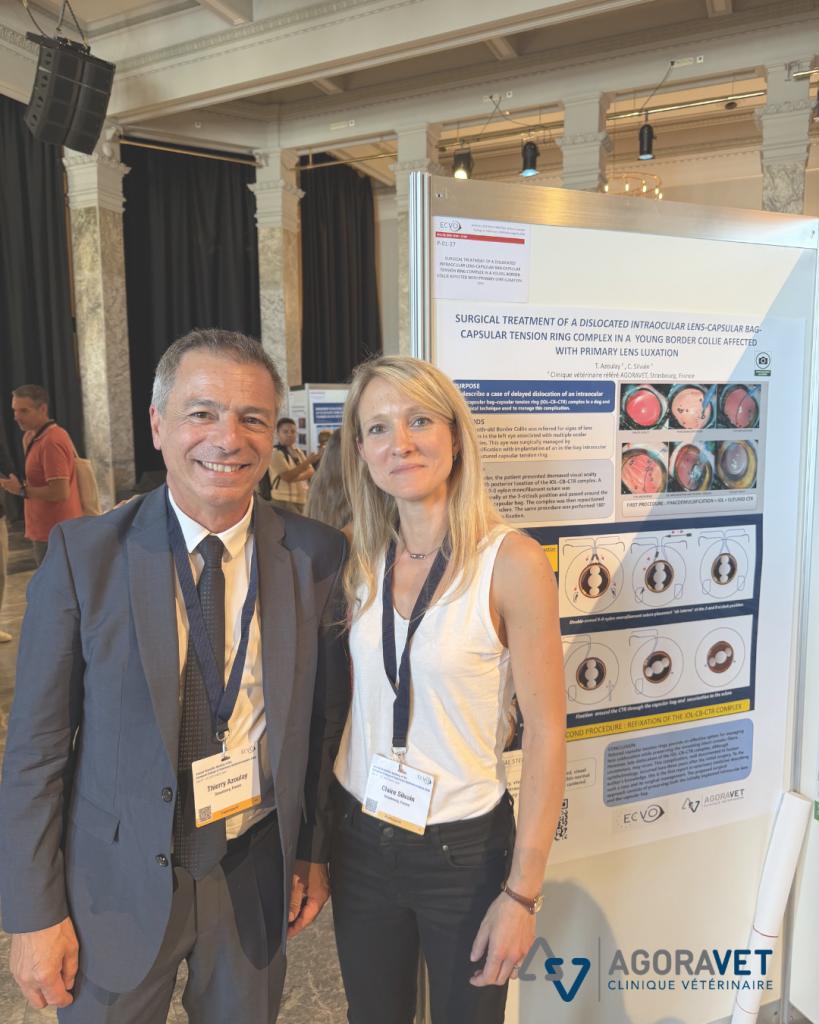
European Congress of Veterinary Ophthalmology – Madrid
Agoravet’s ophthalmology team attended the European Congress of Veterinary Ophthalmology, which was recently held in Madrid.On this occasion, a presentation […]
Read more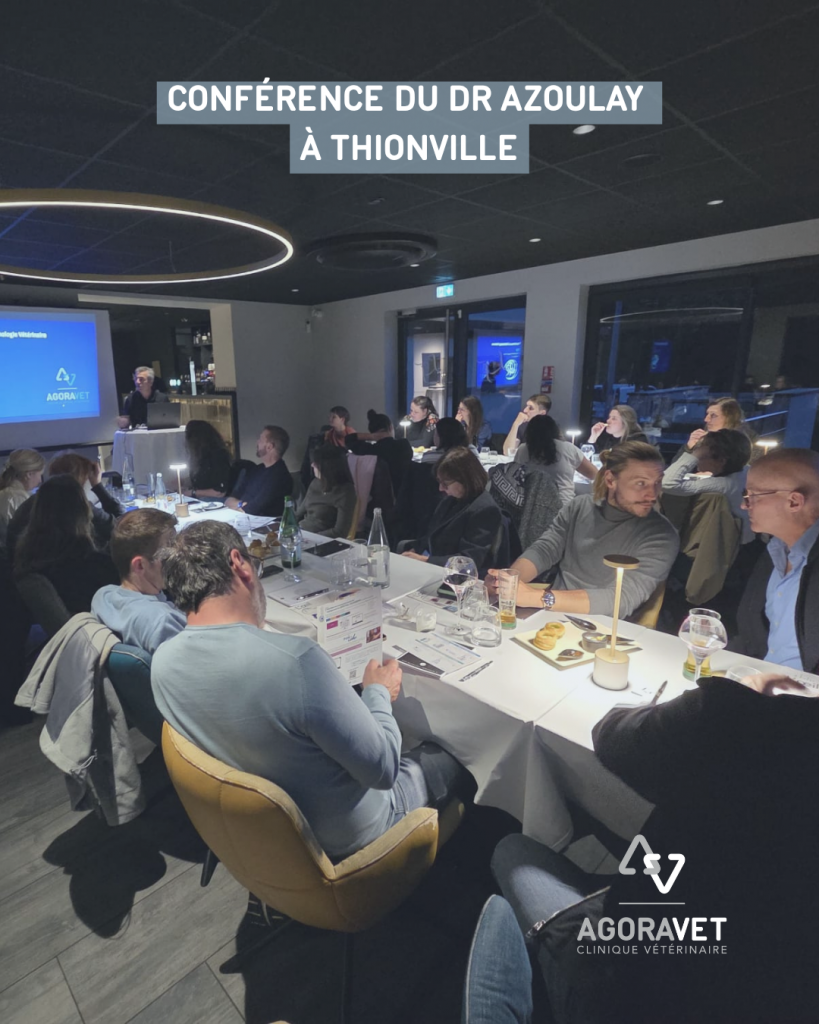
Veterinary ophthalmology conference in Thionville: presentation by Dr Azoulay
Dr Azoulay, a veterinary specialist in ophthalmology at Agoravet, spoke at a conference in Thionville, organized as part of his […]
Read moreClinicat 2026-2027
Will you soon be graduating in veterinary medicine and want to start your career in a 𝗮𝗽𝗽𝗿𝗲𝗻𝗮𝗻𝘁 and 𝘀𝘁𝗶𝗺𝘂𝗹𝗮𝗻𝘁 environment?📍 […]
Read more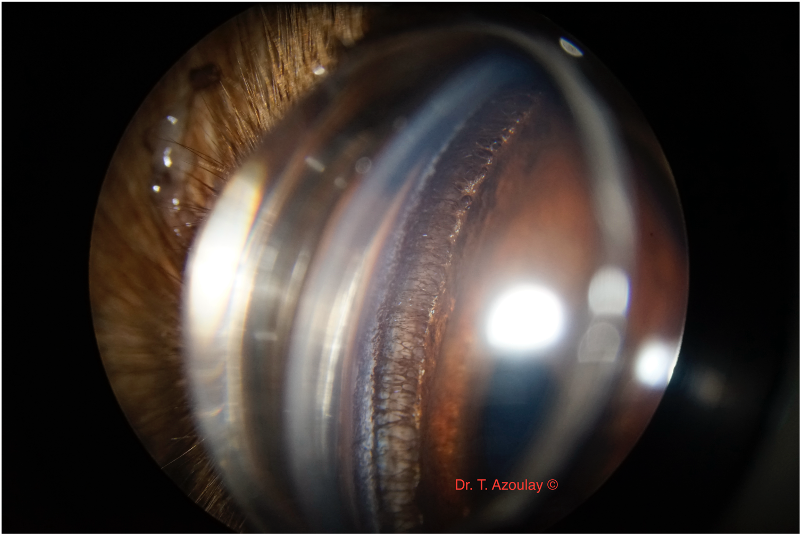
Dr Azoulay’s presentation at AFVAC 2025
Dr Thierry Azoulay, from the Department of Ophthalmology, will present a lecture at AFVAC 2025:” Glaucoma in dogs: when to […]
Read moreOur services
Discover the services offered by the clinic.