




Osteoarthritis and arthritis
Osteoarthritis and arthritis in dogs, cats and NACs
Osteoarthritis is a degenerative joint disease. It evolves chronically, and can affect both young and older animals. Osteoarthritis is a sign of joint disease, often linked to instability and associated with articular cartilage damage and inflammation. It is expressed by pain of varying severity, which progresses in congestive flare-ups.
Osteoarthritis potentially affects all joints, such as elbows, hips, knees, vertebrae (parrot beaks), shoulders ...
Arthritis refers to inflammation of one or more joints (polyarthritis). These diseases can be infectious (septic arthritis), autoimmune or immune-mediated, secondary to Lupus or Rheumatoid Arthritis... In chronic cases, damage to the affected joint leads to the development of osteoarthritis.
Why does my pet suffer from osteoarthritis?
The development of osteoarthritis is a sign of joint suffering. This is the case with hip or elbow dysplasia, with accidents that may have damaged the ligaments or cartilage of a joint, or with repeated micro-trauma caused by heavy sporting activity or chronic overweight.
How can I tell if my pet is suffering from osteoarthritis?
If your dog, cat or NAC has difficulty moving or limps, it may be suffering from osteoarthritis. Sometimes, and in cats in particular, osteoarthritis pain simply manifests itself as a gradual decrease in activity. The animal seems calmer, sleeps more, withdraws.
An examination of your pet by your veterinarian is then necessary. If pain is suspected, he or she may recommend a more thorough examination, such as an X-ray, arthroscopy or even a CT scan, to confirm the presence of osteoarthritis and possibly discover its origin.
How is osteoarthritis treated?
Osteoarthritis cannot be cured. Once it has set in, it does not regress. It is important to limit its progression and treat its negative effects on the animal, namely pain. Numerous solutions exist. Only an examination of your pet and an assessment of its lesions will enable you to determine the most appropriate and personalized treatments. Treatment is usually multimodal, involving :
- A healthy lifestyle: Overweight or obese animals need to lose weight in order to control their pain. Regular, controlled activity is necessary to maintain joint movement and limit ankylosis. Depending on the species to which your pet belongs, a special diet for joint diseases can be introduced. Dietary supplements may also be offered. Although their benefits have not been clearly demonstrated, some animals are genuinely relieved by this nutritional approach (chondroprotectors).
- Pain management: osteoarthritis is permanent, and so is the pain associated with it, even if it evolves in more or less intense flare-ups. Studies have demonstrated the benefits of continuous rather than punctual pain treatment when the pain is too great. Pain treatments have come a long way in terms of both efficacy and tolerability, using anti-inflammatory and analgesic drugs.
- Physiotherapy: for a joint, movement is life. Physiotherapy for our pets is developing rapidly. It enables gentle joint mobilization and muscle strengthening, essential for the stability of ailing joints.
- Surgery: in the case of major joint damage, surgery is necessary to stabilize the affected joint. Sometimes, when pain treatments have reached their limit, surgical treatment can bring relief to your pet.
- Innovative treatments : innovative treatments complement osteoarthritis care solutions.
Platelet plasma concentrate or PRP: this treatment is infiltrated into the painful joint. Blood is taken from the animal, processed by centrifugation and then a portion of it is re-injected into the joint. This treatment, which has long been used in human rheumatology, has interesting anti-inflammatory effects, with no side effects.
Laser treatments: lasers are effective in treating pain. It must be used on a regular basis. Cures of one or more sessions per week for one or two months are usually necessary. This treatment is painless and can be used on all animals;
Stem cells: probably the treatment of the future. It enables partial regeneration of joint structures.
Main orthopedic anomalies
Dislocations
Dislocations in dogs, cats and NACs Dislocations are abnormal displacements of a bone that partially or totally protrude from its […]
Read morePanosteites
Dog panosteitis Panosteitis is a disease of the growing dog between 5 and 15 months of age, mainly affecting the […]
Read moreOsteochondrosis
Osteochondrosis and osteochondritis dissecans in dogs This condition affects the cartilage of certain joints in dogs. Its origin remains uncertain, […]
Read moreFractures
Fracture management What is a fracture? A fracture is a break or crack in a bone. It can occur as […]
Read moreAnomalies of the cruciate ligaments
Cruciate ligament rupture in dogs This anomaly concerns the knee and is mainly found in dogs, but also occasionally in […]
Read moreElbow dysplasia
What is elbow dysplasia? Elbow dysplasia is an anomaly that runs in families and affects certain medium-sized to large dogs. […]
Read more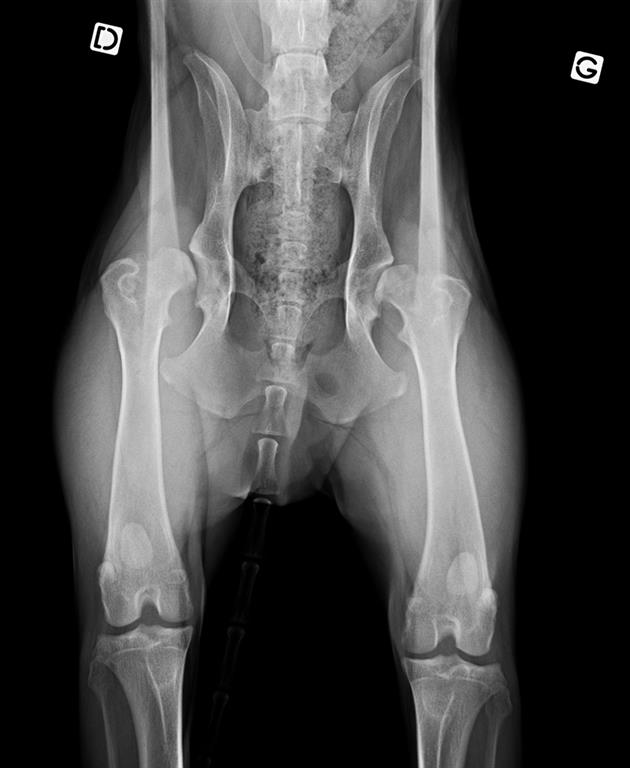
Hip dysplasia
Hip dysplasia in dogs and cats Hip dysplasia is a disease of the dog and cat that affects the joint […]
Read more